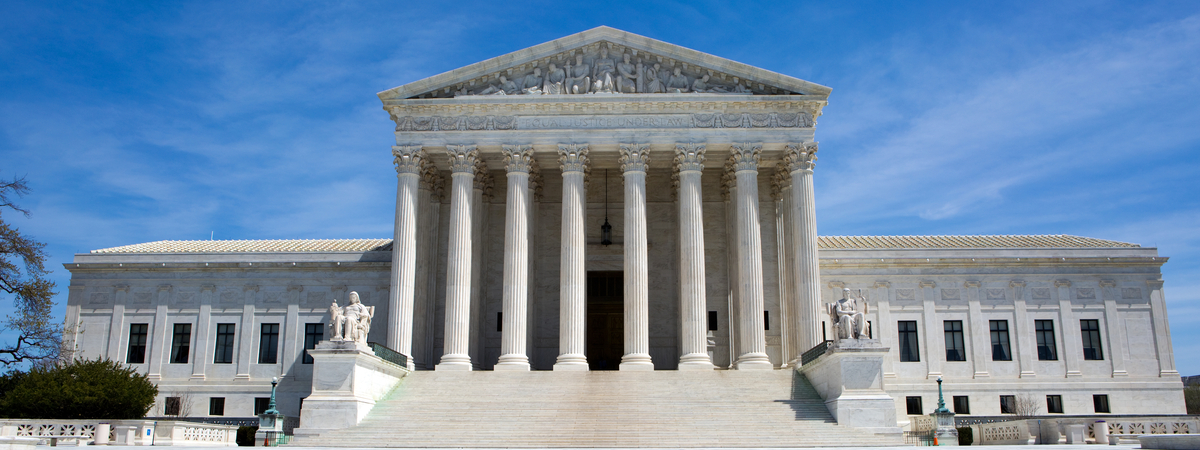
The U.S. Supreme Court held that ICA Section 47(b) creates no implied private right of action for rescission, shifting potential litigation risks for fund governance challenges to SEC enforcement, Section 36(b) claims, and state-law theories.…

Continue Reading Supreme Court Limits Private Rescission Claims Under the Investment Company Act

On May 16, 2024, the U.S. Supreme Court held 7-2 in Consumer Financial Protection Bureau v. Community Financial Services Association of America (CFSA) (Docket No. 22-448) that the CFPB’s funding structure is constitutional. With the Court’s decision, uncertainty over the CFPB’s rulemaking authority tied to the constitutionality of the CFPB’s funding has been removed, clearing…

On Oct. 3, 2023, the U.S. Supreme Court heard oral arguments in Consumer Financial Protection Bureau (CFPB) v. Community Financial Services Association of America (CFSA) (Docket No. 22-448), a case that raises the question of whether the CFPB’s funding structure, by which it receives funding directly from the Federal Reserve rather than via a congressional appropriation, violates the U.S. Constitution’s Appropriations Clause and, if so, what the appropriate remedy should be.…

Continue Reading Supreme Court Hears Oral Argument on Constitutionality of CFPB’s Funding

Welcome to the Spring 2021 issue of Greenberg Traurig’s Financial Services Insights Newsletter. This newsletter reviews certain significant cases and legal developments affecting the financial services industry.

In This Issue:

Spotlight on…

GT Insights

Upcoming Events

Q&A with GT’s Ben Saul: Recent CFPB Developments and Outlook

Sequel to Spokeo: Supreme Court to Address Standing…

On June 22, 2020, in Liu v. SEC, the Supreme Court affirmed in an 8-1 ruling that the Securities and Exchange Commission may continue to pursue disgorgement awards under the federal securities law provided that the award is capped at the defendant’s net profits, and further, provided that the award is made for the

…

In a previous GT Alert, we summarized and analyzed the Supreme Court’s June 21, 2018, decision in Lucia v. Securities & Exchange Commission, 138 S. Ct. 2044 (2018). That GT Alert cited the SEC’s 30-day stay of “all administrative proceedings” “before an administrative law judge” and foretold continued uncertainty concerning the status of administrative…

On Feb. 21, 2018, the U.S. Supreme Court held that the anti-retaliation provision of the Dodd-Frank Act (DFA) protects only employees who complain to the Securities and Exchange Commission (SEC) and not those who make only internal complaints.

In a unanimous decision, the justices ruled in favor of Digital Realty Trust (Digital Realty), finding that…

On Monday, June 26, 2017, the U.S. Supreme Court agreed to review whether the Dodd-Frank Act (DFA) prohibits retaliation against internal whistleblowers or only covers individuals who report to the U.S. Securities and Exchange Commission (the SEC).

This question has divided practitioners and lower courts alike since Dodd-Frank’s passage in 2010. As reported in our…

At the urging of both an individual petitioner and the SEC, the Supreme Court has agreed to resolve a recent circuit split as to whether the five-year limitations period applicable to SEC enforcement actions applies to the remedy of disgorgement. Kokesh v. SEC, __ S. Ct. __, No. 16-529, 2017 WL 125673 (U.S. Jan.…

On Nov. 3, 2016, the Florida Supreme Court issued its long-awaited decision in Bartram v. U.S. Bank National Association, No. SC14-1265, 2016 WL 6538647 (Fla. Nov. 3, 2016), bringing much-needed clarity to the outstanding question of whether the dismissal of a mortgage foreclosure action more than five years after it was filed bars the lender…