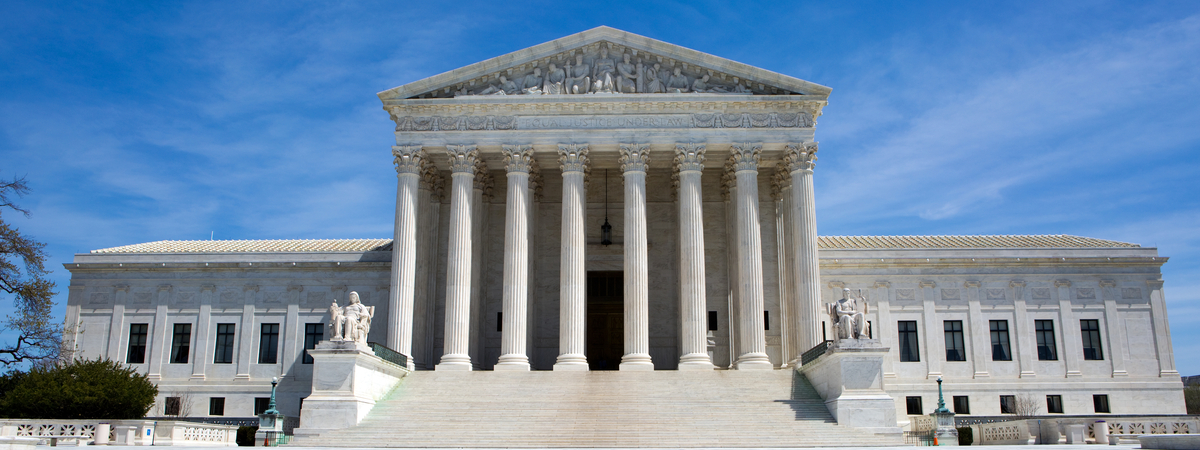
The U.S. Supreme Court held that ICA Section 47(b) creates no implied private right of action for rescission, shifting potential litigation risks for fund governance challenges to SEC enforcement, Section 36(b) claims, and state-law theories.…

Continue Reading Supreme Court Limits Private Rescission Claims Under the Investment Company Act

On May 16, 2024, the U.S. Supreme Court held 7-2 in Consumer Financial Protection Bureau v. Community Financial Services Association of America (CFSA) (Docket No. 22-448) that the CFPB’s funding structure is constitutional. With the Court’s decision, uncertainty over the CFPB’s rulemaking authority tied to the constitutionality of the CFPB’s funding has been removed, clearing…

On Oct. 3, 2023, the U.S. Supreme Court heard oral arguments in Consumer Financial Protection Bureau (CFPB) v. Community Financial Services Association of America (CFSA) (Docket No. 22-448), a case that raises the question of whether the CFPB’s funding structure, by which it receives funding directly from the Federal Reserve rather than via a congressional appropriation, violates the U.S. Constitution’s Appropriations Clause and, if so, what the appropriate remedy should be.…

Continue Reading Supreme Court Hears Oral Argument on Constitutionality of CFPB’s Funding

On June 22, 2020, in Liu v. SEC, the Supreme Court affirmed in an 8-1 ruling that the Securities and Exchange Commission may continue to pursue disgorgement awards under the federal securities law provided that the award is capped at the defendant’s net profits, and further, provided that the award is made for the

…

In a previous GT Alert, we summarized and analyzed the Supreme Court’s June 21, 2018, decision in Lucia v. Securities & Exchange Commission, 138 S. Ct. 2044 (2018). That GT Alert cited the SEC’s 30-day stay of “all administrative proceedings” “before an administrative law judge” and foretold continued uncertainty concerning the status of administrative…

Jennifer L. Gray, co-chair of the Consumer Financial Services Litigation Practice, will be speaking at the 2017 Mortgage Bankers Association (MBA) Legal Issues & Regulatory Compliance (LIRC) Conference. This four-day event will take place May 7-10, 2017, at the InterContinental Miami.

Gray will be presenting on the panel “Litigation Forum: TILA, RESPA, ECOA,…

At the urging of both an individual petitioner and the SEC, the Supreme Court has agreed to resolve a recent circuit split as to whether the five-year limitations period applicable to SEC enforcement actions applies to the remedy of disgorgement. Kokesh v. SEC, __ S. Ct. __, No. 16-529, 2017 WL 125673 (U.S. Jan.…

On Nov. 3, 2016, the Florida Supreme Court issued its long-awaited decision in Bartram v. U.S. Bank National Association, No. SC14-1265, 2016 WL 6538647 (Fla. Nov. 3, 2016), bringing much-needed clarity to the outstanding question of whether the dismissal of a mortgage foreclosure action more than five years after it was filed bars the lender…

In a 110-page decision issued on Oct. 11, 2016, the United States Court of Appeals for the District of Columbia Circuit declared the Consumer Financial Protection Bureau’s (CFPB) single-director structure unconstitutional and vacated a $103 million fine against PHH.  The Court found that the current structure allows the Commissioner to wield too much power that is unchecked by any other part of government.  To remedy this concern, the Court severed the “for cause” provision from the statute, placing the agency under the direct supervision of the president.  The Court also vacated the Order against PHH, finding that the CFPB’s interpretation of RESPA violated PHH’s due process rights in several respects. First, the Commissioner erred in disregarding long-standing guidance from the Department of Housing and Urban Development (HUD) recognizing that Section 8 of RESPA allows captive reinsurance arrangements so long as the amount paid by the mortgage insurer for the reinsurance does not exceed the reasonable market value of the reinsurance.  The Court declared that Section 8 shall continue to have the meaning ascribed to it by HUD.  Secondly, in calculating the penalty against PHH, the Commissioner had improperly included loans that had closed more than three years prior to the action.  The Court rejected the CFPB argument that it was not subject to any statute of limitations, and ruled that the agency was subject to the three-year limitations period that has traditionally applied to agency actions to enforce RESPA.

As we wrote about previously, this case stems back to a June 2015 CFPB order in which CFPB Director Richard Cordray singlehandedly increased a $6 million fine levied by an administrative law judge against PHH for allegedly referring consumers to mortgage insurers in exchange for kickbacks in violation of the Real Estate Procedures Act (RESPA).  The ALJ’s fine was based upon loans closed on or after July 21, 2008..  PHH appealed that ruling to the Director.  Cordray issued a final order that required PHH to disgorge $109 million – all the reinsurance premiums it received on or after July 21, 2008.On appeal, PHH challenged Cordray’s authority to levy the additional fine and challenged the constitutionality of the CFPB itself.

Continue Reading U.S. Court of Appeals for the District of Columbia Circuit Declared CFPB’s Single-director Structure Unconstitutional

Last week, the Ninth Circuit held, in Bourne Valley Court Trust v. Wells Fargo Bank, NA that Nevada’s super-lien priority statute, NRS § 116.310, prior to certain amendments enacted in 2015, was facially unconstitutional.

Nev. Rev. Stat. 116.3116 establishes that liens resulting from non-payment of homeowners’ association (HOA) have priority over other secured liens for …